September 4, 2026
Solid Gold vs. Plated: Why It Matters at 12mm
We never plate. At 12mm a coating has far more surface to lose and far more skin to touch — the honest comparison between solid metal, vermeil, gold filled, and plating.
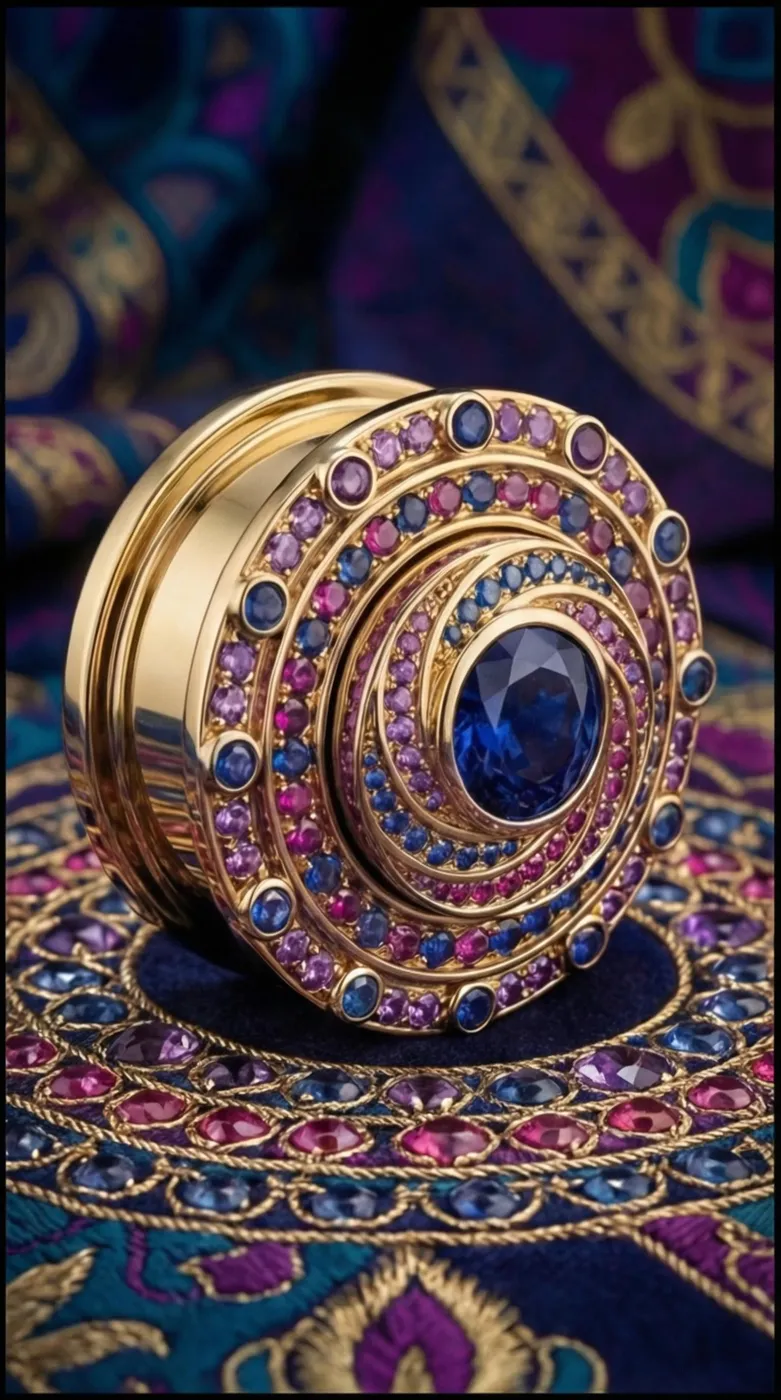
PLUGS+ has one position on metal, and it has never moved: we never plate. Solid gold, solid sterling silver, and nothing pretending to be either.
That sounds like a slogan. It is really a consequence of the size we work at. A plated ring and a plated 12mm plug are not the same product with different price tags — the physics of the thing change once the piece gets large and sits flat against skin all day. Here is the honest version of why.
What plating actually is
Plating is a thin layer of precious metal deposited over a cheaper base metal — usually brass, sometimes steel or a base alloy. The colour on day one is real gold colour, because it is real gold; there just is not much of it.
The industry describes coatings in three broad grades:
| Term | What it means | Practical durability |
|---|---|---|
| Gold plated / flash plated | An extremely thin electroplated layer, often well under a micron | Months at best on a high-contact piece |
| Gold vermeil | Plating over sterling silver, with a regulated minimum thickness in some markets | Better, but still a coating over another metal |
| Gold filled | A thick gold layer mechanically bonded to a base core, by weight a defined fraction of the piece | Years, but still a layer with an edge |
| Solid gold (10k / 14k) | Gold alloy all the way through | Wears; does not run out |
None of these is a scam. Gold filled in particular is a genuinely good material for the right piece. The question is not whether a coating is honest — it is what a coating is being asked to do.
Why gauge changes the arithmetic
Take a stud earring. The visible face might be four or five millimetres across, it touches skin at one small point, and it spends most of its life still.
Now take a 12mm double-flared plug. The front face is roughly six times the area of that stud. The wearing surface is not just the face: it is the barrel inside the piercing channel, and the back flare, and both flare edges. All of it sits against skin, hair, pillow, collar, headphone pad, shirt shoulder — pressed and rotated, hundreds of times a day.
A coating fails at edges and high-contact points first. On a plug, the flare edges are exactly where the piece bears against the lobe. So the wear starts where the piece is thinnest and shows first where the piece is most visible.
And there is a second problem that only appears at size: a worn patch on a large face is not subtle. On a stud, a rubbed edge reads as patina. On a 12mm face, a patch of exposed base metal is a stripe you can see from across a room.
Skin contact, and why healed lobes are unforgiving
A stretched lobe is a healed piercing, not an open wound, so the usual sterility conversation does not apply the same way. But it is still a continuous, warm, occlusive contact surface. Sweat, body oil and soap residue sit in the channel between skin and barrel.
When a coating wears through anywhere on that barrel, the base metal underneath is now what your lobe is in contact with, all day, under a film of moisture. Base alloys commonly contain nickel, which is one of the most frequent contact allergens there is — and sensitisation is cumulative. Plenty of people find out they react to nickel only after years of low-level exposure.
This is the part of the plated conversation that generally goes unsaid. A worn coating is not just a cosmetic problem; it silently swaps the material touching you for a different one, and you usually cannot see the moment it happens because it happens inside the piercing channel first.
Solid metal cannot do that. A 14k gold plug that has dulled is still 14k gold at every point on its surface, and always will be. There is nothing to wear through to.
The honest tradeoffs of going solid
We would rather you buy solid from someone else than buy plated from us, but that does not make solid metal free of downsides. There are four, and they are real.
Weight. Gold is dense — noticeably denser than sterling silver, and vastly denser than acrylic or silicone. A large solid pair has presence. That heft is a good part of why people want it, but if you are freshly stretched, or you have thin front walls, or you are having a long day, a heavy pair is a load your lobes are carrying. Rotate with something lighter. This is not a compromise; it is what everyone who wears heavy jewellery well actually does.
Price. Solid metal costs what solid metal costs, and the cost scales with volume — which means it scales fast with gauge. Doubling a plug's diameter multiplies the metal in it far more than twofold. That is why a 20mm pair is not "a bit more" than a 10mm pair. Payment plans are available at checkout, subject to approval and terms set by the provider; see financing for how that works.
Care. Solid does not mean indifferent. Every metal tarnishes under body oils left to sit, and hand-polished finishes dull under abrasives and chlorine. The routine is small but it is not nothing — see caring for gold and stones you wear every day.
Sizing. Because heavier metals feel tighter than plastic at the same measurement, size from the guide rather than from the acrylic pair you have been wearing. If you are between rungs, size down. The true-size visualiser exists for exactly this.
Sterling silver, honestly
Silver is the other solid metal we work in, and it deserves a straight description rather than being treated as gold's understudy.
Sterling is 92.5% silver, alloyed for strength. It is lighter than gold, considerably less expensive, and takes a bright polish that some people prefer to any gold tone. It also tarnishes — that is a chemical reaction with sulphur compounds in air and on skin, not a defect and not a coating failing. Tarnish comes off; it does not consume the piece. If you like the look of white metal and want a large gauge without a large invoice, sterling silver is the answer, and it is a solid one in both senses.
What you get instead of a coating
Every pair is cast, set and hand-finished to order and ships in 4–6 weeks. Because there is no coating, everything downstream gets simpler:
- Free polish and re-finish for life. Send the pair back whenever it dulls and it comes back looking like the day it left the bench — no charge, no limit on how often. On a plated piece this service could not exist: polishing removes material, and on a coating the material is the coating.
- Repairs at cost. Bent post, lost stone, cracked flare — fixed for the price of materials and bench time, never marked up.
- A piece that can be re-worked. Solid metal can be re-polished, re-set, and in some cases re-finished to a different texture years later. A coated piece is a fixed object; once the layer is gone, it is gone.
Shipping to us is on you; shipping back is on us. Loss and theft are not covered.
The short version
If you wear plugs occasionally, in small sizes, and you like changing colour often, plating is a reasonable, cheap way to do that, and there is no shame in it.
If you wear one pair daily, at 12mm or larger, against healed skin, for years — a coating is being asked to do something it was not built for, and the failure mode is invisible until it is not. That is the whole argument.
Browse the materials directly: solid gold, sterling silver, or the full shop from 3mm to 25mm.
Made to order
Browse the sizes currently available for each piece, or request another measurement through Custom.
Shop the gauges