August 25, 2026
Moissanite vs. Lab Diamond vs. Natural Stones in Plugs
Hardness, fire, and what each option costs once you are setting a matched pair rather than a single stone. An honest comparison, with no disparagement of any of them.
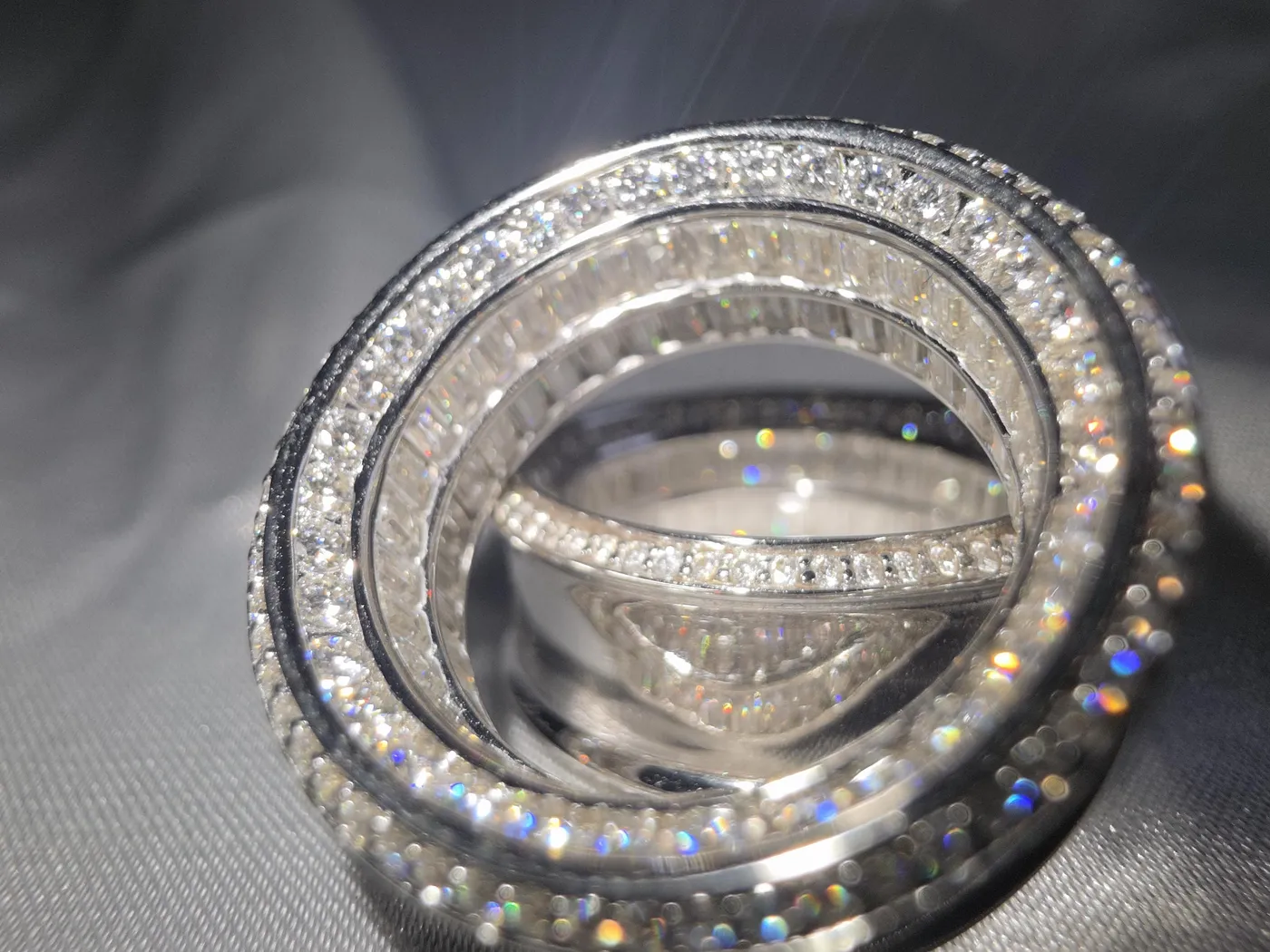
Setting stones in plugs is not the same problem as setting stones in a ring, and the usual jewellery advice does not transfer cleanly.
A ring carries one centre stone. A pair of plugs carries two faces that have to match each other, seen side by side, on the same person, from three feet away. Multiply that by a face diameter of 12mm or more and you are setting a lot of stones — which changes the maths of every choice below.
Here is the honest comparison. We set all three categories. We are not going to tell you one of them is fake.
The short table
| Moissanite | Lab diamond | Natural diamond | Coloured natural stones | |
|---|---|---|---|---|
| Hardness (Mohs) | ~9.25 | 10 | 10 | 7 to 9 depending on species |
| Optical character | Higher dispersion — more coloured fire | Diamond-identical | Diamond-identical | Varies enormously |
| Origin | Lab-grown silicon carbide | Lab-grown carbon | Mined carbon | Mined |
| Cost at pair scale | Lowest by a wide margin | Middle | Highest | Anywhere on the scale |
| What it is | Its own mineral | Chemically diamond | Chemically diamond | Its own mineral |
Hardness, and the thing hardness does not tell you
The Mohs scale measures resistance to scratching, and only that. It is not a measure of toughness — resistance to chipping or fracture — and the two are genuinely different properties.
Diamond, natural or lab, sits at 10: nothing in ordinary life will scratch it. Moissanite is roughly 9.25, which is still above almost everything a stone meets day to day, including the quartz dust in household grit that dulls softer stones over years. In practical terms both are effectively scratch-proof for the life of a piece.
Where they differ is at the edges. Diamond has cleavage planes; a sharp knock at the wrong angle on an exposed girdle can chip it despite the hardness. Moissanite has no comparable cleavage and is often described as tougher against impact, though a hard enough hit will damage anything.
For plugs specifically, the exposure question matters more than either number. A stone set flush in a channel or bezel, sitting proud of nothing, is protected. A prong-set stone standing above the face is beautiful and slightly more exposed to doorframes, headphone pads and pillows. That is a setting decision, not a stone decision, and it is worth thinking about if you sleep in your jewellery.
Fire, brilliance, and what people actually notice
Three optical properties do the work:
- Brilliance — white light returned to the eye.
- Fire (dispersion) — white light split into spectral colours.
- Scintillation — the flash pattern as the piece moves.
Moissanite has notably higher dispersion than diamond. That is a measurable material property, not marketing: it throws more coloured flash, and under direct light — sun, stage lights, a phone torch — it reads as rainbow rather than white.
Whether that is better depends entirely on what you want. Some people love it and choose moissanite specifically for it. Others find it reads differently from the white, icy look they had in mind and prefer diamond for exactly that reason. Neither position is wrong, and nobody should be told their preference is a compromise.
At large gauges, scale amplifies the difference. Twenty small moissanites across a 16mm face throw a lot of colour under movement. If you like the effect, big is where it becomes spectacular. If you wanted restraint, the same effect can be more than you intended, and a smaller stone count or a diamond option will read cleaner.
Lab diamond and natural diamond are the same material with the same optical properties. A lab diamond does not look different from a mined one, because it is not different — same chemistry, same crystal structure, same everything a gemmologist measures except the growth history, which is what laboratory equipment is required to determine.
Cost, at pair scale
This is where the choice usually resolves, and where plugs diverge from rings most sharply.
A ring needs one good stone. A matched pair of stone-set plugs needs two identical faces, each with anywhere from a handful to several dozen stones, all matched for colour and cut. Every incremental cost per stone is multiplied by that count — and then by two.
Moissanite is dramatically less expensive per carat than either diamond option. At pair scale that is not a small saving; it is often the difference between a piece existing and not existing. It is why a fully iced 16mm pair in moissanite is achievable and the same design in diamond is a commission.
Lab diamond sits in the middle and has fallen substantially in price as production has scaled. Natural diamond remains the most expensive of the three, and carries a resale and heirloom context the others do not, for reasons that are about market and history rather than material.
None of that makes any option the "smart" choice. A natural stone bought because you value that it came out of the ground is a perfectly rational purchase. A moissanite pair bought because you would rather have a bigger, bolder piece for the same money is equally rational. They are different purchases.
Coloured natural stones
Emerald, sapphire, ruby and amethyst behave differently from the colourless options, and each brings a maintenance profile.
Sapphire and ruby (both corundum, Mohs 9) are exceptional daily-wear stones — hard, tough, and stable. If you want colour with the fewest caveats, this is it.
Emerald (beryl, 7.5–8) is where care matters. Most emeralds, including very fine ones, are treated with oil or resin to improve the appearance of their natural inclusions. That is standard, disclosed practice — but it means emerald pieces must never see an ultrasonic cleaner, a steam cleaner or hot water, any of which can strip the treatment. Warm water, mild soap, soft brush. Emeralds are also more included by nature than other stones, which makes them somewhat more brittle than the hardness number implies.
Amethyst (quartz, 7) is fine for daily wear but will pick up scratches against harder stones, which is the practical argument for storing pairs separately rather than loose in a dish.
Full care detail for all of these is in caring for gold and stones you wear every day.
Setting matters as much as stone
Whatever you choose, the setting decides how long it stays where it was put.
- Channel and bezel settings enclose the stone. Lower profile, better protected, cleaner line — the sensible default for a piece worn daily and slept in.
- Prong settings lift the stone and let light in from more angles. More sparkle, more exposure.
- Pavé covers a face with many small stones for continuous coverage, and needs the most careful cleaning behind the stones.
Regardless of setting, never put stone-set jewellery in an ultrasonic cleaner. Vibration is the single most common cause of loose stones we see, and a loose stone that keeps being worn becomes a lost stone. Repairs are covered at cost under the Lifetime Care Guarantee, but the stone itself is easier to keep than to replace.
How to choose
Ask three questions, in this order.
- What look do you want? Rainbow fire or white ice. This narrows it faster than any other question.
- What is the budget for the pair, not the stone? Multiply by stone count and by two.
- How do you wear them? Sleep in them, gym in them, work with your hands — favour protected settings and the tougher stones.
Everything is cut, set and hand-finished to order and ships in 4–6 weeks, so there is time to change your mind before the bench starts, and none afterwards. If you are torn, write; we will tell you plainly which we would set for the design you have in mind.
Browse by stone: moissanite, lab diamond, or the iced baguette work. Sizing first? Start with the size guide and the mm-to-gauge chart.
Made to order
Browse the sizes currently available for each piece, or request another measurement through Custom.
Shop the gauges